Gray iron and ductile iron are both cast irons with roughly 3–4% carbon. The difference is the shape of the graphite: flakes in gray iron, spheres (nodules) in ductile iron. That single microstructural difference changes almost every property that matters to a design engineer.
Property comparison
| Property | Gray iron (ASTM A48 Class 30) | Ductile iron (ASTM A536 65-45-12) |
|---|---|---|
| Tensile strength (min.) | 30 ksi (207 MPa) | 65 ksi (448 MPa) |
| Yield strength (min.) | Not specified | 45 ksi (310 MPa) |
| Elongation | under 1% | 12% |
| Vibration damping | Excellent | Good |
| Machinability | Excellent | Good |
| Relative cost | Lowest | approx. 10 – 25% higher |
When gray iron is the better choice
- Machine bases, frames and housings where stiffness and damping matter
- Brake drums and rotors, where thermal conductivity is critical
- Pump and compressor housings with heavy machining
- Parts loaded mainly in compression
When ductile iron is the better choice
- Parts carrying tensile, bending, impact or fatigue loads
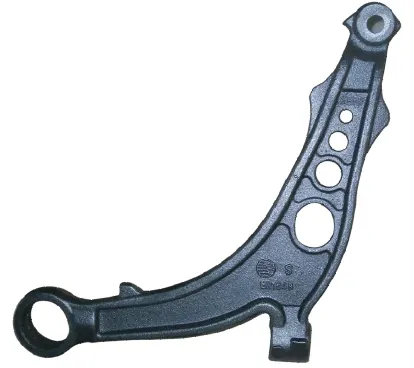
- Suspension arms, brackets, hubs and yokes
- Replacing steel weldments or forgings at lower cost
- Pressure-containing valve and fitting bodies
Common grade equivalents
- Gray iron: ASTM A48 Class 30 ≈ EN-GJL-200 ≈ GB HT200; Class 40 ≈ EN-GJL-300 ≈ HT300
- Ductile iron: A536 65-45-12 ≈ EN-GJS-450-10 ≈ QT450-10; 80-55-06 ≈ EN-GJS-600-3 ≈ QT600-3
Equivalents are approximate — always specify the US standard on your drawing and ask your foundry for test-bar results with each heat.