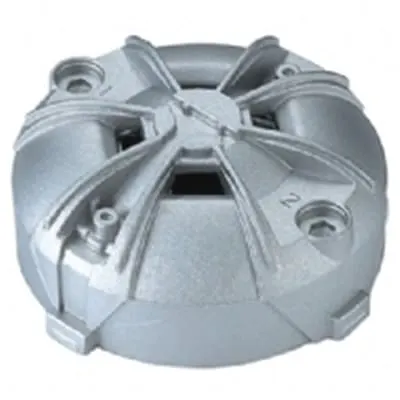
Aluminum parts can be cast by three closely related permanent-mold processes: gravity casting, low-pressure die casting (LPDC) and high-pressure die casting (HPDC). Choosing the wrong one is one of the most common reasons casting programs go over budget — through extra tooling, extra machining or scrap from porosity. This guide summarizes how our engineers make the choice.
The short answer
| Factor | Gravity (permanent mold) | Low-pressure (LPDC) | High-pressure (HPDC) |
|---|---|---|---|
| Best annual volume | 500 – 20,000 | 2,000 – 100,000 | 5,000 – 500,000+ |
| Tooling cost | Low – medium | Medium | High |
| Minimum wall | approx. 3 – 4 mm | approx. 3 mm | approx. 1.5 – 2 mm |
| T6 heat treatment | Yes | Yes | Generally no |
| Internal soundness | Good | Excellent | Fair (gas porosity) |
| Typical alloys | A356, 319, 355 | A356, A357 | A380, ADC12, A383 |
Choose high-pressure die casting when
- Annual volume is high enough to amortize a hardened steel die
- Walls are thin and the part is close to net shape
- Cosmetic surface quality matters for powder coat or paint
- The part does not need T6 heat treatment or welding
Choose low-pressure casting when
- The part is round or symmetric — wheels, motor housings, end covers
- You need X-ray quality or high elongation after T6
- The part is large but still thin-walled
Choose gravity casting when
- Volumes are low to medium and tooling budget is limited
- The part needs sand cores for internal passages
- Strength and pressure tightness matter more than wall thickness
Total cost, not unit price
A die casting may quote 20–30% cheaper per piece, but if the part then needs impregnation, extra machining stock or suffers leak-test rejects, gravity or low-pressure casting can be cheaper overall. Always compare tooling amortization, machining time, secondary operations and expected scrap.
Not sure which process fits your part? Send us your model — we will quote more than one option when it makes sense.